When building applications in Swift, you constantly need to compare objects, sort arrays, or store unique items in a Set or Dictionary. To do this efficiently, Swift relies on three fundamental protocols: Equatable, Comparable, and Hashable.
While these protocols are easy to adopt, their behavior differs significantly depending on whether you are using a struct or a class. Let’s break down why we need them and how to implement them correctly.
1. Equatable
Why do we need it?
By default, Swift does not know how to check the equality of two custom objects. If you try to use the == operator on a standard struct, the compiler will throw an error.
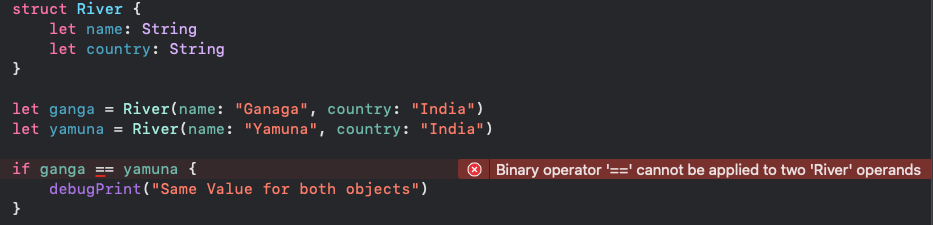
Without Equatable, your only option is to manually compare the properties every single time, which is tedious and error-prone:
struct River {
    let name: String
    let country: String
}

let ganga = River(name: "Ganga", country: "India")
let yamuna = River(name: "Yamuna", country: "India")

// ❌ Not ideal: Manual property comparison
if ganga.name == yamuna.name && ganga.country == yamuna.country {
    debugPrint("Same Value for both objects")
}
Implementing Equatable for Structs
Swift makes this incredibly easy for value types. If all properties inside your struct already conform to Equatable (like String and Int), you simply add the protocol conformance, and Swift synthesizes the logic for you.
struct River: Equatable {
    let name: String
    let country: String
}

let ganga = River(name: "Ganga", country: "India")
let yamuna = River(name: "Ganga", country: "India")

// ✅ Clean and native
if ganga == yamuna {
    debugPrint("Same Value for both objects")
}
Custom Equality:
If you only want to compare specific properties (e.g., only checking the country), you can explicitly implement the == method:
struct River: Equatable {
    let name: String
    let country: String

    static func == (lhs: Self, rhs: Self) -> Bool {
        return lhs.country == rhs.country
    }
}
Implementing Equatable for Classes
Classes are reference types, which means Swift does not automatically synthesize initializers or Equatable conformance for them.
Even after you write the initializer, the compiler still won’t know which properties dictate equality. You must manually implement the == method.
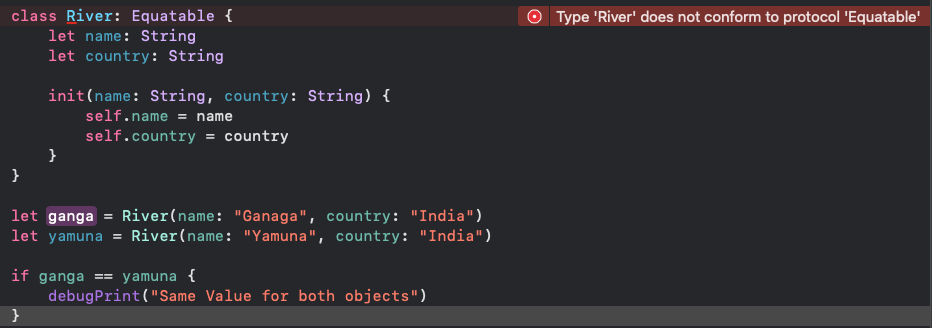
class River: Equatable {
    let name: String
    let country: String

    init(name: String, country: String) {
        self.name = name
        self.country = country
    }

    // Required for classes!
    static func == (lhs: River, rhs: River) -> Bool {
        return lhs.country == rhs.country
    }
}
2. Comparable
The Comparable protocol inherits from Equatable. It allows you to use relational operators like <, >, <=, and >=. This is essential if you want to use methods like .sorted() on an array of your custom types.
To conform, you only need to implement the < (less than) operator. Swift will automatically infer the rest based on < and ==.
Structs
struct River: Comparable {
    let name: String
    let country: String
    let length: Int // KM

    static func < (lhs: River, rhs: River) -> Bool {
        return lhs.length < rhs.length
    }
}

let ganga = River(name: "Ganga", country: "India", length: 2525)
let yamuna = River(name: "Yamuna", country: "India", length: 1376)

if yamuna < ganga {
    debugPrint("Yamuna's length is smaller than Ganga")
}
Classes
Just like with Equatable, classes get no automatic synthesis. Because Comparable inherits from Equatable, a class adopting Comparable must implement both the < method and the == method explicitly.
class River: Comparable {
    let name: String
    let country: String
    let length: Int // KM

    init(name: String, country: String, length: Int) {
        self.name = name
        self.country = country
        self.length = length
    }

    // 1. Conform to Comparable
    static func < (lhs: River, rhs: River) -> Bool {
        return lhs.length < rhs.length
    }

    // 2. Conform to Equatable requirements
    static func == (lhs: River, rhs: River) -> Bool {
        return lhs.name == rhs.name && lhs.country == rhs.country
    }
}
3. Hashable
A hash value is a large integer representation of an object. Swift uses this integer to quickly look up items in a Set or a Dictionary. The hash value may change each time the program runs, but it remains consistent during a single execution.
(Note: The Hashable protocol also inherits from Equatable, meaning any type that is Hashable must also be Equatable).
Structs
For structs where all properties are already Hashable (like standard strings and integers), Swift synthesizes the conformance automatically.
struct River: Hashable {
    let name: String
    let country: String
}

let ganga = River(name: "Ganga", country: "India")
let yamuna = River(name: "Yamuna", country: "India")

print(ganga.hashValue) // e.g., -749079774561398480
print(yamuna.hashValue) // e.g., 2503812864319202522
Custom Hashing:
If you want to manually dictate which properties are fed into the hashing algorithm (for instance, to ignore the name and only hash the country), you implement hash(into:).
struct River: Hashable {
    let name: String
    let country: String

    func hash(into hasher: inout Hasher) {
        hasher.combine(country)
    }
}
Classes
As you might have guessed, classes require manual implementation. You must provide the hash(into:) method AND the == method.
class River: Hashable {
    let name: String
    let country: String

    init(name: String, country: String) {
        self.name = name
        self.country = country
    }

    // 1. Feed properties into the hasher
    func hash(into hasher: inout Hasher) {
        hasher.combine(country)
    }

    // 2. Provide Equatable logic
    static func == (lhs: River, rhs: River) -> Bool {
        return lhs.country == rhs.country
    }
}
Summary
- Structs do most of the heavy lifting for you. Swift automatically synthesizes
EquatableandHashableif the properties support it. - Classes require you to manually write the
==,<, andhash(into:)methods. - If you adopt Hashable or Comparable, you must also ensure your object conforms to Equatable.